Tools
Fuel consumption calculator
L/100 kmestimate
–
km/L
–
Cost per km
–
Cost of 100 km
–
Monthly cost
–
This is an estimate for one fill-up. The most accurate figure is the average of several fill-ups, which the app works out for you.
Enter a valid number
How to measure fuel consumption the right way
The most accurate method is “full tank to full tank”. Don't go by the fuel gauge or the amount you paid; use litres and distance.
Steps
- Fill the tank until the nozzle clicks off, and reset the trip meter (or note the odometer).
- Drive as usual, ideally until the gauge is at half or lower.
- Fill up to full again, and note the litres from the pump and the distance from the trip meter.
- Enter both numbers in the calculator.
The formula
Consumption (L/100 km) = litres ÷ distance × 100. Example: 40 litres over 500 km = 8 L/100 km, or 12.5 km per litre.
What if I didn't fill up completely?
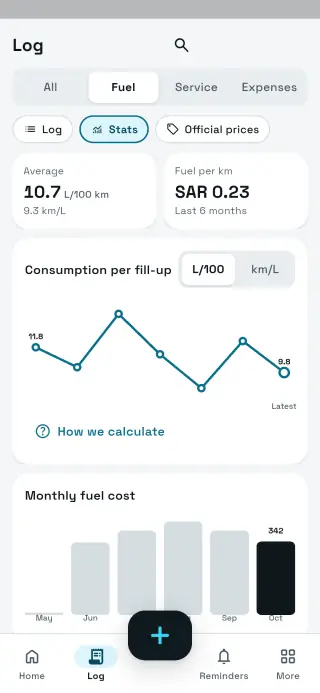
A partial fill-up can't give a correct figure on its own. Add up the litres of every fill-up until the next full one, then divide by the whole distance. The app does this for you, and also handles a fill-up you forgot to log.
Measuring by the tank
Using tank size and the km until the low-fuel light comes on only gives a rough figure, because the light comes on with an unknown amount left. It's better to fill up and read the litres from the pump.
What's a normal fuel consumption?
It depends on engine size, driving style and traffic. Rough figures for mixed city and highway driving:
| Car | L/100 km | km/L |
|---|---|---|
| Small car (1.2–1.6 L) | 5–7 | 14–20 |
| Mid-size sedan (1.6–2.5 L) | 7–10 | 10–14 |
| Large SUV or pickup | 11–16 | 6–9 |
| Hybrid | 4–6 | 17–25 |
Rough figures for comparison only; your car's number is the one you measure.
Why is my car using more fuel?
- Tyre pressure below spec, especially in the heat
- A dusty, clogged air filter
- Overdue oil change or spark plugs
- Stop-and-go traffic and long idling with the AC on
- High speeds above 120 km/h
- Extra load in the boot or on the roof
More than one car? Compare their consumption
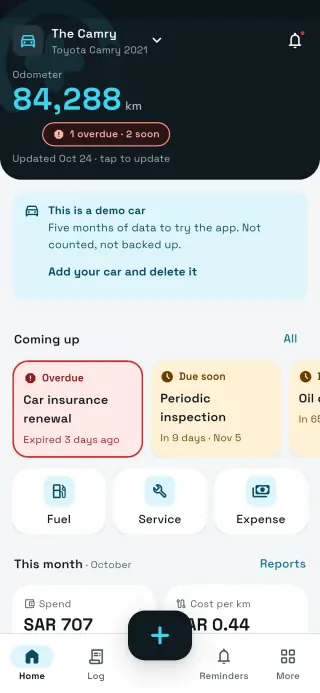
In a company or a family, the fastest way to spot a problem is to compare: two cars of the same model with a 20% gap in consumption means tyres, a filter or a driving habit worth a look. Start with the free fuel consumption sheet, or let Sayarti+ Business compare each car with its own average and alert you when it uses more than usual.
FAQ
FAQ
How do I calculate km per litre?
Divide distance by litres: 500 km ÷ 40 L = 12.5 km/L. For L/100 km, divide litres by distance and multiply by 100.
Which is better, L/100 km or km/L?
Both are right. L/100 km is easier for comparing cars (lower is better); km/L is easier day to day (higher is better).
How do I work out fuel cost per km?
Multiply litres by the price per litre, then divide by the distance. Example: 40 L × 2.33 = 93.2, ÷ 500 km = 0.19 per km.
Does 91 vs 95 change consumption?
Use the grade your owner's manual recommends. Higher octane doesn't cut consumption in a car designed for a lower one; it only raises the cost.
Why is my number different from the car's display?
The display is the car computer's estimate and can be a little off. The full-tank method uses the actual litres from the pump.
Do you store the numbers I enter?
No. The calculator runs on your device and doesn't send your numbers to us.
How do I compare several cars or drivers?
Work out L/100 km for each car, full tank to full tank, over the same period, then compare cars of the same model. Sayarti+ Business does it automatically and flags any car above its own average.
Sources
- fueleconomy.gov · Keeping your vehicle in shape (US Department of Energy)
- fueleconomy.gov · Driving more efficiently
- fueleconomy.gov · Hot weather driving
- NRCan · Fuel-efficient driving techniques (Natural Resources Canada)