1. Put every car in one register
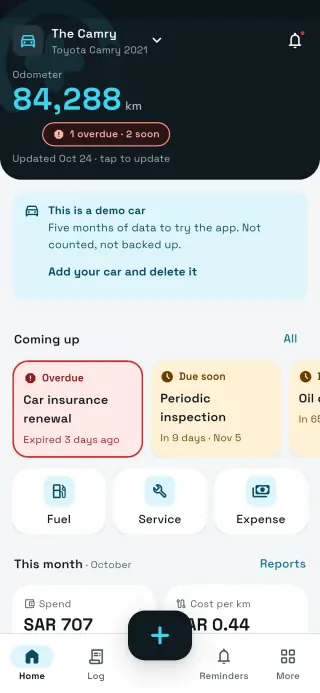
Start with a single list of every car: make, model, year, plate, colour, today's odometer and who drives it. That's all you need to begin. The usual mistake is information split between the accountant, the manager and the driver, so nobody has the full picture.
Start with a spreadsheet if you like, but keep one file with one owner. Company car tracking template
2. Collect every expiry date
For each car: registration or vehicle licence, insurance and periodic inspection. For each driver: their licence expiry (the date, not the number). Set a reminder a month and a week ahead, because renewal sometimes needs an inspection or paid fines first. The renewal itself happens on your country's official portal.
3. Record every handover
When a car goes to or comes back from an employee, write down the odometer, fuel level, visible damage and accessories, take photos, and both sign. It settles disputes at the first scratch or fine. When the car moves between drivers, change who's responsible in your register the same day.
4. Service by kilometres, not memory
Work cars cover far more kilometres than personal ones, in heat, dust and traffic. Give each car its next service by km or date, whichever comes first, and ask drivers to update the odometer weekly. Oil, filters, tyres and brakes matter most.
Fleet maintenance schedule template Car maintenance schedule
5. Every fill-up with its receipt
Ask for every fill-up to be logged: date, odometer, litres, amount, receipt photo and who filled up. Without the odometer you can't work out consumption; without the receipt you can't check it. Make logging easy for drivers, or it won't happen.
6. Compare consumption every month
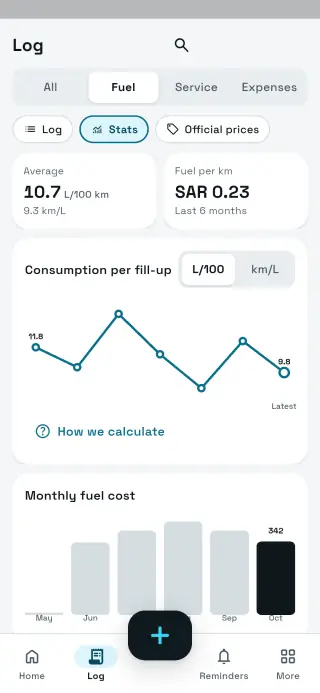
For each car, work out litres per 100 km full tank to full tank, then compare similar cars. A car clearly above its usual average deserves a check: tyre pressure, a fault, a driving habit, or fuel that doesn't end up in the car. Ask before you accuse; many gaps have a mechanical cause.
7. Know each car's cost per km
Add up everything spent on the car over the period (fuel, service, insurance, fees, repairs, and its instalment if any) and divide by the kilometres it covered. That number tells you which car is due for replacement, whether an allowance beats a company car, and what each delivery trip costs.
Cost per km = total car costs in the period ÷ kilometres driven in the same period
8. A short usage policy and a monthly report
Write a one-page policy every driver signs: who may drive, personal use (allowed or not), who pays fines, how fill-ups are logged, what to do after an accident or breakdown, and when the car comes back. Then, at the start of each month, review a short report: upcoming deadlines, cost per car and per driver, and the highest-consumption cars.
What a company car policy covers
- Authorised drivers
- Personal use and its limits
- Logging fill-ups and the odometer
- Fines: who pays and when
- Accidents and breakdowns: the first step
- Cleanliness and daily checks
- Smoking and passengers
- Returning the car on leave or when leaving the job
FAQ
What matters most in a small fleet?
Never missing an expiry, and logging every fill-up and service with its receipt. Those two prevent most losses: fines, big repairs and wasted fuel.
How do I cut fleet fuel costs?
Compare each car with its own average, check tyre pressure monthly, cut idling, plan routes to reduce kilometres, and require a receipt for every fill-up.
How do I cut fleet maintenance costs?
Preventive service on time is cheaper than repairs after a breakdown. Stick to the oil, filter, brake and tyre schedule, and log every service so you can see which car keeps breaking down.
Do I need GPS to manage a fleet?
Not always. GPS helps when the car's location is part of your work or required for your activity. Deadlines, costs and service can be managed without it.
Who pays fines on a company car?
Your employment contract and usage policy decide that. Write it down clearly, have each driver sign it, and log every fine against the car and driver on its date.
Is Sayarti+ linked to a government body?
No. Sayarti+ is an independent app, not affiliated with any government entity. Renewals and fines are handled on your country's official portal.
Sources
- US Department of Energy (fueleconomy.gov): Driving more efficiently; how aggressive driving and idling raise fuel use — checked 28 October 2026
- US Department of Energy (fueleconomy.gov): Keeping your car in shape; tyre pressure and recommended oil grade — checked 28 October 2026
- Natural Resources Canada: Fuel-efficient driving techniques — checked 28 October 2026
- Sayarti+: default hot-climate maintenance schedule — checked 28 October 2026

We write practical guides on car costs, maintenance and company cars. Every number has a source.