Why does the manual give two numbers?
Most service booklets have one schedule for normal conditions and another for severe ones. “Severe” usually covers high temperatures, dusty roads, stop-and-go traffic, short trips where the engine never fully warms up, and towing or heavy loads. In Saudi Arabia, the Gulf and Egypt most drivers tick more than one of these, so the severe interval is usually the right one.
What if you don't drive much?
Oil ages even when the car doesn't move much, which is why booklets give months as well as kilometres. If you don't reach the km within 6–12 months, change the oil when the time is up.
Mineral or synthetic?
Synthetic oil handles heat better and lasts longer, which is why it allows longer intervals. But the right oil is the one your manual specifies, including viscosity (such as 0W-20 or 5W-30). Don't change viscosity just because a workshop suggested it without checking the manual.
Oil types at a glance
| Mineral | Semi-synthetic | Fully synthetic | |
|---|---|---|---|
| Highway interval | 5,000 km or 6 months | 7,500 km or 6 months | 10,000 km or 12 months |
| Heat, traffic and dust | 3,000–5,000 km or 3–6 months | 5,000 km or 6 months | 5,000–7,500 km or 6 months |
| Heat tolerance | Lower | Medium | Highest |
| Price | Cheapest | Mid | Highest |
| Usually suits | Older cars whose manual specifies it | Moderate daily use | Modern cars, extreme heat, long distances |
Our cautious estimate; your manual is the reference
The dearest isn't always the costliest: a synthetic oil changed half as often can cost the same per year as a mineral one. Count the changes per year.
Oil changes in Gulf and Egyptian heat
In summer the air can pass 45 °C in many Gulf cities, and the engine idles in traffic with the AC on. Heat speeds up oil oxidation and thins it, so it protects the engine less over time. That's why Sayarti+ defaults to 5,000 km or 6 months, shorter than the severe-conditions interval in some manuals (8,000 km or 6 months in Hyundai's, for example) to allow for the heat, and you can lengthen it if your manual allows.
In Saudi Arabia and the Gulf
Check the oil level before long intercity trips: high speed plus heat is the hardest combination. In dusty areas, check the air filter at every oil change.
In Egypt
City traffic and short trips stop the engine warming up properly, which also counts as severe use. If your car runs on CNG, follow the manual and the fitting centre on the oil interval.
Maintenance schedule for hot climates
When do I change the oil filter?
Follow your manual for oil and filter changes. If it allows a new filter every other oil change, the price difference is small, so we prefer changing it every time.
Signs your oil needs changing
- The oil light or a service message
- Oil on the dipstick is black and thick, or below the mark
- The engine sounds louder than usual
- You've passed the km or the time
A red oil-pressure light means stop now and have the car checked.
How to check the oil level yourself in two minutes
Park on level ground and wait 5 minutes after switching off.
Pull out the dipstick and wipe it with a clean cloth.
Push it fully back in, then pull it out again.
The oil should sit between the two marks; if it's near the minimum, top up with the same type and viscosity.
If you topped up, note it in Sayarti+: needing oil again and again is worth a check.
Some newer cars have no dipstick and show the level on the screen; follow the manual.
How not to forget the next oil change
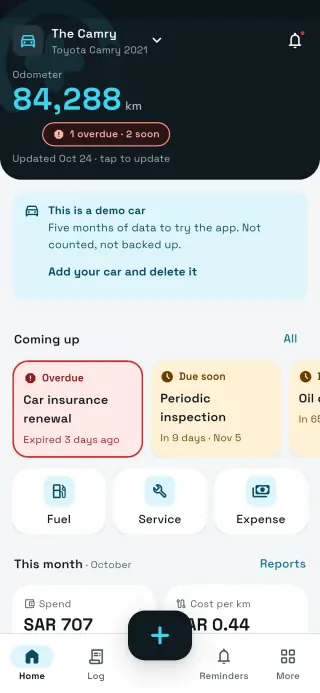
Note the km and date at every change. In Sayarti+, log the service once: it works out the next one by km or date, whichever comes first, predicts when you'll reach it from your average daily driving, and reminds you before.
Oil changes for company cars
In a fleet each car covers a different distance, so one date for all doesn't work. It's easier to work out each car's next change by km or date, whichever comes first. In Sayarti+ Business the driver logs the oil change with the odometer, and the next reminder goes to the owner, the managers and the car's driver. If you're starting with a spreadsheet, download the free fleet maintenance schedule template.
Fleet maintenance schedule template (Excel)Sayarti+ Business
FAQ
When is the first oil change on a new car?
Follow the dealer schedule in the warranty booklet; some makers ask for an early first change. Keep the receipt for your warranty.
5,000 or 10,000 km?
It depends on the oil, your driving and the manual. With heat and traffic, use the manual's severe interval (8,000 km in Hyundai's, for example; Sayarti+ starts at a cautious 5,000 km). On highways with synthetic oil it can be longer if the manual allows.
Change it if I haven't reached the km?
Yes, when the time limit is up, because oil ages over time.
How often in Egypt?
Same rule: your manual first; with city traffic and heat, use the severe interval. Sayarti+ starts at 5,000 km or 6 months.
Should I change the oil earlier in summer?
Not if you already follow the severe-conditions interval (from your manual, or 5,000 km or 6 months in Sayarti+). Just check the level before trips and don't run past the date.
How often does a company or delivery car need an oil change?
Usually by km rather than date, because it reaches 5,000 km fast. A car doing 4,000 km a month may need a change every 5–6 weeks.
Sources
- Hyundai online owner's manual: Maintenance Under Severe Usage and Low Mileage Conditions; oil every 8,000 km or 6 months in traffic, dust and short trips — checked 28 October 2026
- Mobil: Mobil 1 FAQs; follow the oil and filter change intervals in your owner's manual — checked 28 October 2026
- US Department of Energy (fueleconomy.gov): Keeping your car in shape; use the manufacturer's recommended grade of oil — checked 28 October 2026
- Sayarti+: default hot-climate maintenance schedule; oil every 5,000 km or 6 months — checked 28 October 2026

We write practical guides on car costs, maintenance and company cars. Every number has a source.