Car depreciation: rates in Saudi Arabia and Egypt, with examples
How to depreciate a car: straight-line and declining balance with SAR and EGP examples, Saudi and Egyptian tax rates, and the effect on cost per km.
Reviewed 8 min read
 Sayarti+ teamReviewed 8 min read
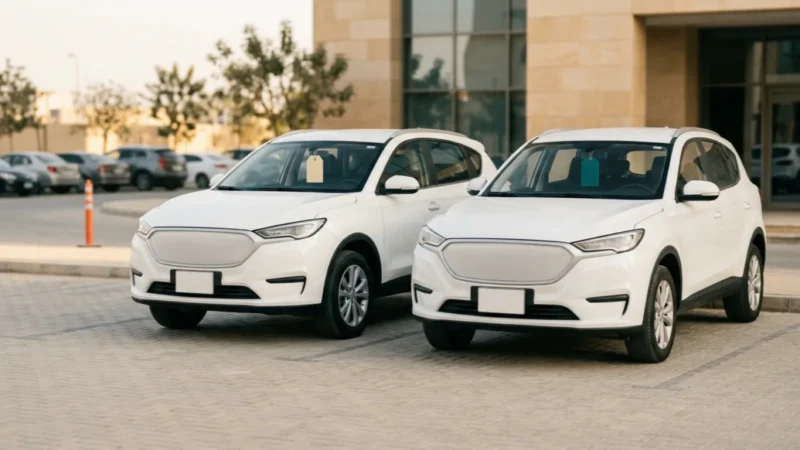
Buying usually costs less if you keep cars long (4+ years), have cash or good financing, and can manage servicing. A long-term lease suits you if you want one fixed monthly payment that includes insurance and service, newer cars, and cash not tied up in vehicles. Compare full cost per km, not the monthly payment alone.
Long-term business leases (usually 2–4 years) bundle into one monthly payment most of what you'd pay yourself when buying. But what's covered differs between contracts, so read every clause:
| Item | Usually included? |
|---|---|
| Use of the car | Yes |
| Insurance | Often comprehensive; check the excess |
| Scheduled service | Usually |
| Tyres and battery | Sometimes, or up to a limit |
| Registration and annual fees | Varies by contract: ask explicitly |
| Replacement car | In some contracts |
| Fuel and fines | No, always on you |
| Extra km | No, charged per km over the limit |
The figures below are illustrative for a mid-size sedan in Saudi Arabia doing 40,000 km a year (120,000 km over 3 years). Replace them with your real numbers and quotes. Fuel is left out because it's the same either way.
| Item | Amount (SAR) |
|---|---|
| Car price | 90,000 |
| Financing cost over 3 years (example) | 9,000 |
| Comprehensive insurance (3,500 × 3) | 10,500 |
| Service, tyres, battery (3 years) | 7,500 |
| Annual fees and inspection (3 years) | 1,000 |
| Less: expected resale after 3 years | −50,000 |
| Net cost | 68,000 |
| Per month | ≈ 1,889 |
| Per km | ≈ 0.57 |
| Item | Amount (SAR) |
|---|---|
| Monthly payment incl. insurance and service (example) × 36 | 2,000 × 36 = 72,000 |
| Extra-km charges (if the limit is 40,000/year) | 0 |
| Return damage charges (allowance) | 1,000 |
| Net cost | 73,000 |
| Per month | ≈ 2,028 |
| Per km | ≈ 0.61 |
In this example buying is about SAR 5,000 cheaper over 3 years. But three things can easily flip the result:
Same logic, with two big differences. First: car prices in EGP move hard with the exchange rate, so a used car may sell years later for close to, or more than, what you paid in EGP, which favours buying when you have the cash. Second: EGP financing is usually expensive at current interest rates, so buying on instalments can end up dearer than leasing. Compare the reducing (effective) rate in the bank's offer, not the advertised flat rate. Run both options with real quotes, the same km and the same term.
Read next: Car loan calculator
| ar |
|---|
| en |
Many companies mix: they buy the core cars that work daily for years, and lease extra cars for a project or a season.
Read next: Car depreciation: how to work it out · Rental fleet maintenance tracking
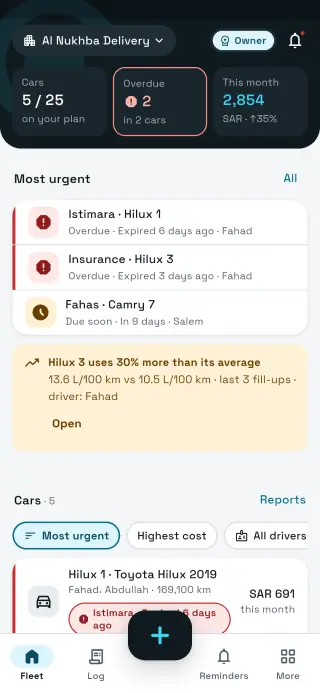
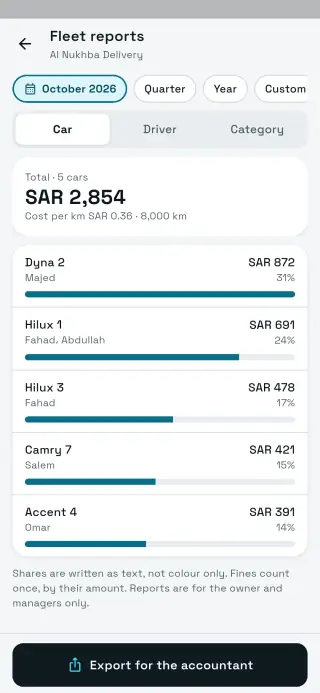
Either way, the question that matters is: what does each car cost per km this month? In Sayarti+ Business, log the instalment or lease payment as a monthly expense on the car, with fuel, service and fines, and you see the monthly cost per car and per driver, and keep an eye on km so you don't overshoot the contract limit.
Not always. Buying usually wins with long ownership and high km; leasing suits those who want a fixed payment and free cash. Work out cost per km for both.
Usually 2–4 years; some contracts run one year.
In most contracts yes, but check the excess and who pays it.
You pay a set rate per extra km at the end of the contract or yearly. Estimate your km before you sign.
Yes, and it's common: core cars owned, extra cars leased for projects and seasons.
Sayarti+ is an independent app, not affiliated with any government entity. This guide is general information; the binding procedure and fees are on the official portal. It is not financial or tax advice.
We write practical guides on car costs, maintenance and company cars. Every number has a source.
From Sayarti+ — sayartiplus.com · Not affiliated with any government entity