Company cars: buy or long-term lease? A worked comparison
Buy company cars or lease them long term? A worked example: price, financing, insurance, service and resale vs the monthly lease, and when each wins.
Reviewed 8 min read
 Sayarti+ teamReviewed 8 min read
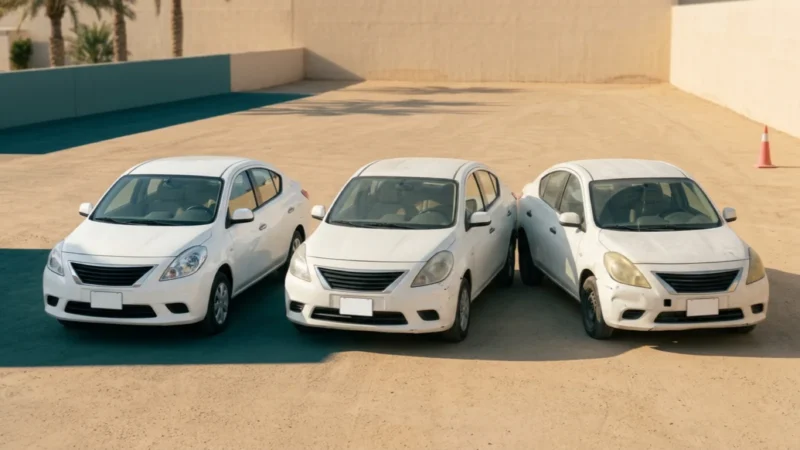
Depreciation spreads a car's price over the years you use it. In your books you estimate its life and leftover value, then expense a share each year. For tax: the Saudi Income Tax Law puts passenger and cargo vehicles in a 25%-a-year group, and Egypt's income tax law depreciates 'all other business assets' at 25% of the depreciation basis. Check with your accountant before closing your accounts.
When your company buys a car for SAR 100,000, it doesn't lose that money on the day of purchase, and it doesn't keep it forever. The car loses part of its value every year through use and age, and depreciation is the accounting way to record that gradual loss as an expense. It has three practical uses: each year's profit reflects the true cost, your cost per km includes the price of the car and not just fuel and service, and you can see when replacing a car beats repairing it.
Good to know: Mind the difference between two things: accounting and tax depreciation (figures in your books, governed by standards and tax rules) and market value loss (what the car will actually sell for). They're sometimes close, but they're not the same.
SAR example (illustrative figures): a company car bought for SAR 100,000 that you expect to sell after 5 years for SAR 30,000. Depreciation = (100,000 − 30,000) ÷ 5 = SAR 14,000 every year, the same each year.
EGP example (illustrative figures): a car bought for EGP 1,200,000, expected to be worth EGP 400,000 after 5 years. Depreciation = (1,200,000 − 400,000) ÷ 5 = EGP 160,000 a year.
Here a fixed rate is applied to the remaining book value each year, not the original price. Depreciation is large in the early years and then shrinks, which mirrors what happens to a car in the market: the biggest drop in value comes in the first year or two.
| Year | Value at start | Depreciation 25% | Value at end |
|---|---|---|---|
| 1 | 100,000 | 25,000 | 75,000 |
| 2 | 75,000 | 18,750 | 56,250 |
| 3 | 56,250 | 14,063 | 42,188 |
| 4 | 42,188 | 10,547 | 31,641 |
| 5 | 31,641 | 7,910 | 23,730 |
Compare: straight-line in the earlier example gives SAR 14,000 every year; declining balance gives 25,000 in year 1 and 7,910 in year 5. The 5-year totals are close (70,000 vs about 76,270), but the timing differs.
In the books, the company chooses the method and useful life under the accounting standards adopted in the Kingdom (IFRS as endorsed by the Saudi Organization for Chartered and Professional Accountants), and your accountant sets the right life for how your cars are used; our examples assume 5 years for illustration only.
For tax, Article 17 of the Income Tax Law splits depreciable assets into five groups. Group 3 is 'plant, machinery, equipment, software and devices, including passenger and cargo vehicles', at 25%. The charge is the rate applied to the group's remaining value at the end of the tax year, so it declines at group level rather than per car, and half the cost of assets bought during the year enters that year's balance, the other half the next year (paragraph (e) of the same article). This law covers income-tax payers; businesses subject to zakat follow the zakat regulations, so ask your accountant how it applies to you.
Read next: Income Tax Law, Article 17 (ZATCA, Arabic PDF)
In the books, Egyptian companies follow the Egyptian Accounting Standards and set a car's useful life with their accountant. For tax, Article 25 of Income Tax Law No. 91 of 2005 depreciates 'all other business assets' at 25% of the depreciation basis each tax year (computers and software at 50%). Cars aren't named, so they normally fall under 'other assets'. The basis (Article 26) is the book value at the start of the period, so it shrinks every year: a declining balance. This is the law as published in the Official Gazette in 2005; check with your accountant for later amendments and how it applies to your business.
| Year | Start value | Depreciation | End value |
|---|---|---|---|
| 1 | 1,200,000 | 300,000 | 900,000 |
| 2 | 900,000 | 225,000 | 675,000 |
| 3 | 675,000 | 168,750 | 506,250 |
Read next: Income Tax Law 91/2005 (Egyptian Tax Authority, Arabic PDF)
There's no single life for every company. A car doing 60,000 km a year (delivery or transport) wears out faster than a manager's car doing 15,000. Pick the life from your actual use and replacement plan, and stick to it. A used car is depreciated from the price you paid, over the life you expect to keep it, not from its price when new.
Example: (SAR 100,000 − 30,000) ÷ 150,000 km = SAR 0.47 per km. That figure is added to fuel, service and insurance. Many companies forget it, so they think the car is cheaper than it is, or that buying always beats leasing.
Read next: Buy or lease company cars · Monthly car costs
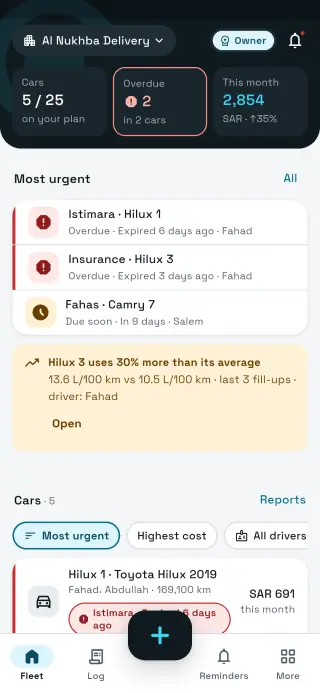
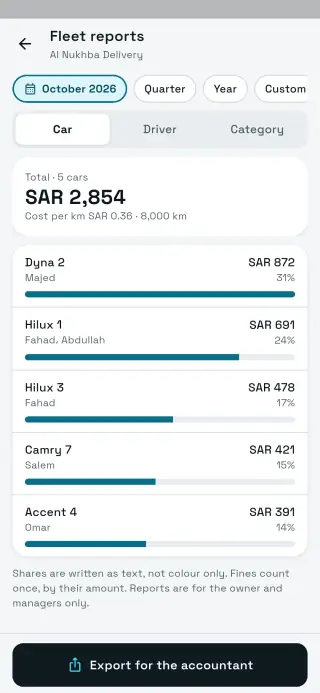
To work out depreciation and cost per km you need: purchase price and date, the odometer on purchase day and monthly, every expense on the car, and the sale price and date when you let it go. In Sayarti+ Business you log all of that per car and export a monthly or any-period report by car, driver or category to Excel, CSV or PDF for your accountant.
Read next: Fleet tracking Excel template
For tax, 25% a year on the remaining value of the 'passenger and cargo vehicles' group under Article 17 of the Income Tax Law. In the books the company picks the life and method. Check with your accountant.
For tax, 25% of the depreciation basis (book value) each year, as 'other business assets' under Article 25 of Law 91/2005. In the books the useful life is set with your accountant.
Both are acceptable if they reflect how the car is actually used up and are applied consistently. Declining balance is closer to its market value loss.
No. It's a book expense; the cash left on purchase day. But it's real: you feel it when you sell the car for less than you paid.
It varies by model, market and mileage; the biggest drop usually comes in the first year or two. Compare used prices for the same model to estimate residual value.
Sayarti+ is an independent app, not affiliated with any government entity. This guide is general information; the binding procedure and fees are on the official portal. It is not financial or tax advice.
We write practical guides on car costs, maintenance and company cars. Every number has a source.
From Sayarti+ — sayartiplus.com · Not affiliated with any government entity