
Company car policy: a ready 12-clause template
A company car policy to copy and edit: who may drive, personal use, fuel, fines, accidents, servicing and returning the car, plus how to roll it out.
Reviewed 9 min read
 Sayarti+ teamReviewed 7 min read
In Saudi Arabia, the employee is added as the actual user or authorised to drive the company car online through the company's Absher Business account, where the available service and its conditions are shown, the main ones being a valid istimara and the employee's valid licence. In Egypt a driving power of attorney from the notary is used. Who pays fines is set by company policy and the employment contract; the assignment record proves who was driving.
The car is registered to the company, and an employee drives it. If they're stopped by a patrol, have an accident or need to cross a border, the first question is: are they allowed to drive it? The official authorisation answers that and links the car to a named driver in official records. Without it, the driver may face questions, and the company can end up responsible for things that could easily have been pinned to the right person.
For individuals, the Absher platform lets you authorise someone else to drive your car or add them as the actual user, and any fee is shown in the service before you confirm. For companies, the business's vehicles are managed from its Absher Business account, where the authorisation or actual-user service available to the business, and its steps, are shown to whoever holds that permission.
Duration and cancellation: set a period that fits the contract, and cancel the authorisation on the day the employee leaves or the car moves to someone else. This is the step people forget most, leaving the car linked to someone who has left.
Good to know: The official procedure is on Absher / Absher Business (absher.sa). Sayarti+ issues no authorisation and connects to no government platform; it only reminds you when the authorisation, istimara and insurance expire.
Read next: Istimara renewal: requirements and reminders
In Egypt a driving power of attorney issued at the Real Estate Registration and Notarization office is commonly used: the company (through its legal representative) grants it to the driver, listing the car details and the duration. The documents the company needs and the fees are set by the notary office; notarisation services are listed on Digital Egypt (digital.gov.eg). The driver carries a copy with the car licence and their driving licence. Some companies rely on an internal authorisation letter on company paper, but a notarised power of attorney carries more weight if questions arise.
A fine is recorded against the car or its owner; it doesn't automatically land on the driver in every case. So the company must decide internally who bears each type and write it into the car policy and the employment contract. The split we find sensible:
| Fine type | Usually borne by |
|---|---|
| Speeding, red light, phone, seatbelt | The driver at the wheel |
| Wrong parking on a work task | Per policy (often the driver) |
| Expired istimara, inspection or insurance | The company (renewal is its job) |
| Mechanical fault (lights, tyres) | The company, unless the driver hid the fault |
Watch out: Any pay deduction must comply with labour law and the contract. In Saudi Arabia the Labour Law says nothing may be deducted from wages for private claims without the worker's written consent, except in listed cases (Article 92); deductions to repair damage the worker caused by their own fault may not exceed five days' wages a month (Article 91); and total deductions may not exceed half the wage due unless the labour court allows it (Article 93). In Egypt the Labour Law also sets limits and steps for penalties and pay deductions, including hearing the worker before any penalty, so check the current text with your lawyer. Some fines have a discount window if paid early, so don't delay payment while you wait to recover it from the driver.
Read next: Company car policy template (12 clauses)
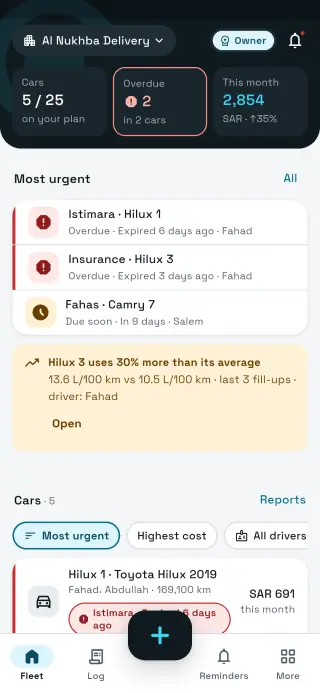
A fine sometimes arrives weeks later. If the car moves between drivers, you won't remember who had it on the 12th of last month. Three records settle it:
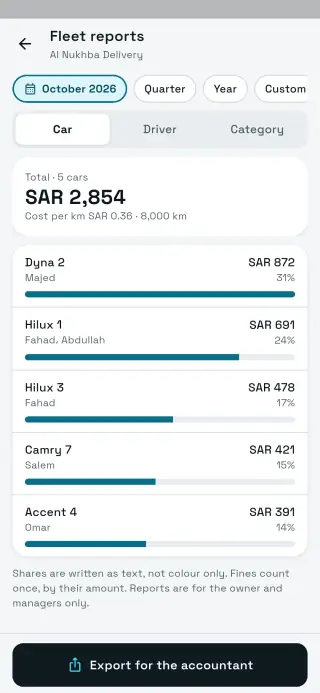
In Sayarti+ Business each car is assigned to one or more drivers, and every entry records who logged it and when. Log the fine in the car's fines list with the amount, date and discount deadline if there is one, and you get a reminder before it ends. Fines count once in reports, as fines, never twice as an expense too.
From the business account on Absher Business, using the authorisation or actual-user service as shown in the account, with a valid istimara and the driver's valid licence.
Any fee is shown in the service itself on Absher or Absher Business before you confirm.
They're recorded against the car or its owner; the company then decides internally who bears them, using a written policy and a record of who was driving.
At Real Estate Registration and Notarization offices. Look up notarisation services on Digital Egypt (digital.gov.eg) before you go.
No. Sayarti+ is an independent app, not affiliated with any government entity. It logs fines and dates and reminds you; procedures and payments happen on the official portal.
Sayarti+ is an independent app, not affiliated with any government entity. This guide is general information; the binding procedure and fees are on the official portal.
We write practical guides on car costs, maintenance and company cars. Every number has a source.
From Sayarti+ — sayartiplus.com · Not affiliated with any government entity