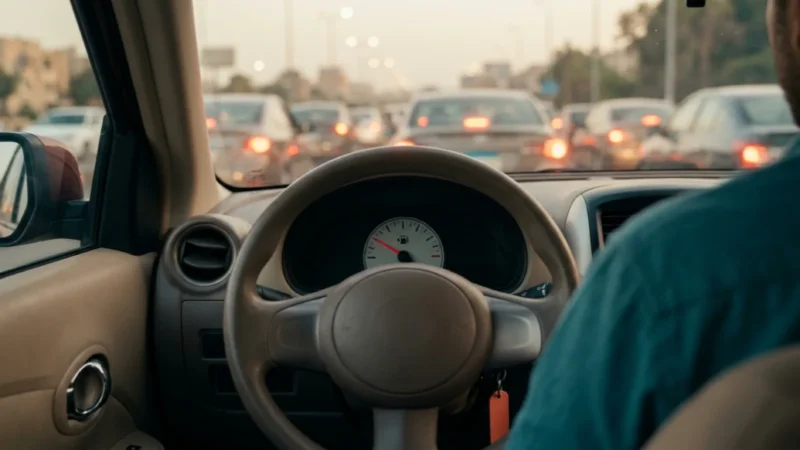
Why is my car using more fuel? Causes and how to check
Is your car burning more fuel? Confirm it with the right maths first, then check 9 causes from cheapest to costliest: tyres, AC, speed, load, faults.
Reviewed 7 min read
 Sayarti+ teamReviewed 8 min read
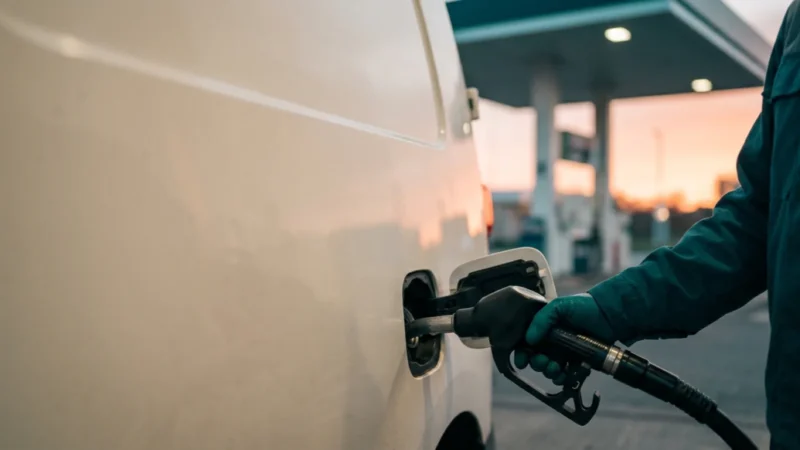
The most common signs of fuel fraud: fill-ups bigger than the tank, fill-ups on days the car doesn't work, a sudden jump in litres per 100 km, repeated round amounts, an odometer that isn't updated, and missing receipts. The fix: log every fill-up with odometer, receipt photo and who filled up, compare each car with its own average, and ask before you accuse.
Most consumption gaps have innocent mechanical or operational causes: low tyre pressure, AC running for hours while parked, heavier traffic than usual, a heavier load, or a faulty sensor. Fraud, when it happens, is usually small repeated amounts that are hard to see in one monthly bill. So the goal isn't to catch drivers but a system that makes the numbers so clear that fraud isn't worth trying, and protects honest drivers from suspicion.
Read next: Mechanical reasons a car uses more fuel
A car with a 60-litre tank and a receipt for 75 litres. Part of it went into another car or a can. Even a full 60 is rare, because tanks are rarely run completely dry.
In a sheet: a 'tank size' column per car and a rule that highlights any fill-up above 90% of it.
In the app: litres show with every fill-up, its receipt photo and who logged it.
A Friday fill-up for a car that stays parked on days off, or a fill-up while the driver is on annual leave.
In a sheet: a weekday column next to the date, compared with the work schedule and leave.
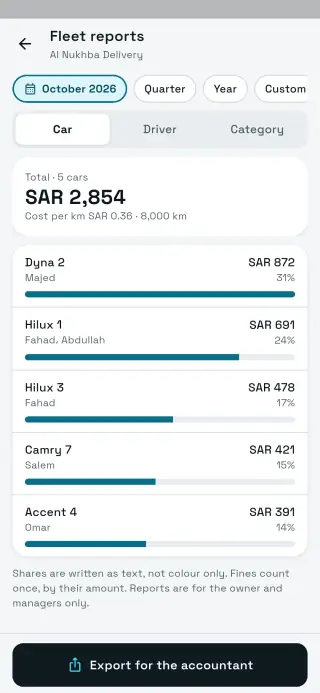
In the app: every fill-up has its date, time and who logged it; filter the report by driver.
A car that used 9 L/100 km now uses 12 with no change in routes or load. A 30% jump deserves a question. Check tyres, filters and sensors first, then review the fill-ups.
In a sheet: monthly consumption per car against its average, flagged at +20% and +30%.
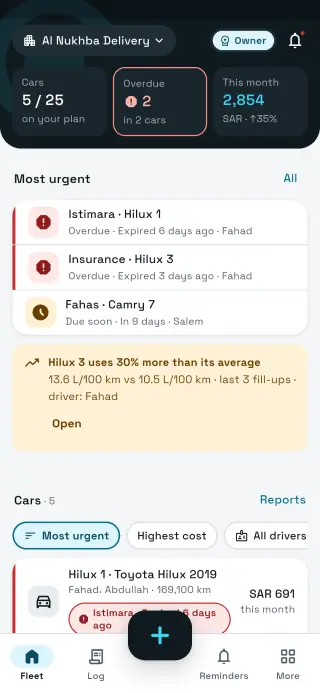
In the app: the fleet dashboard alerts you when a car uses more than its average, e.g. 'car X uses 30% more than its average': it compares the last 3 fill-ups with the previous 90 days and needs at least 3 earlier fill-ups.
SAR 200, 200, 200 every time, or exactly EGP 500. Paying a fixed amount isn't wrong in itself, but with 'full tank' fill-ups it's unlikely to be round every time. Handwritten receipts with round amounts are a clearer sign.
In a sheet: a column that checks whether the amount is a multiple of 50 or 100, counted per driver.
In the app: the station's printed receipt photo with each fill-up shows the real litres and price.
Fill-ups without an odometer reading, the same reading on two fill-ups, or an impossible jump. Without the odometer, consumption can't be worked out at all, which is why it's the first thing to slip.
In a sheet: make odometer a required field and highlight any reading lower than the last.
In the app: the odometer is asked with every fill-up, and a lower reading shows 'Lower than the last reading: is this a correction?', so mistakes don't pass silently.
A delivery car working the north of the city, filling up every time at a station in the south near the driver's home. It may be justified; it may not.
In a sheet: a 'station' column copied from the receipt; sort by station per car.
In the app: the station is saved with each fill-up and shows on the receipt photo. (We don't track the car's location; Sayarti+ doesn't use GPS.)
'I forgot the receipt' once is fine. Every week isn't. And receipts that all arrive at month end in one pile are hard to match to odometer and date.
In a sheet: a 'receipt: yes/no' column and the share of fill-ups without a receipt per driver.
In the app: the driver photographs the receipt at the pump from their phone, even offline; it uploads when they're back online.
Tip: Put fuel rules into the company car policy before any problem: every fill-up with a receipt and odometer the same day, the allowed fuel grade, and what isn't reimbursed.
Read next: Company car policy template
The more cars, drivers and daily fill-ups, the harder manual checks get. Delivery companies in particular handle dozens of fill-ups a week, and a small gap per fill-up becomes a big yearly sum: 10 extra litres a week per car across 20 cars = over 10,000 litres a year.
Read next: Delivery fleet costs
Don't start with an accusation. Compare the car's consumption with its own average, check fill-ups bigger than the tank, on days off and without receipts, and rule out faults first.
5–10% is normal with heat, traffic and loads. Over 20% deserves a question; over 30% deserves a check.
They cut cash payments and give a record, but on their own they don't catch fuel going into another car. You still need the odometer and a consumption check. (Sayarti+ doesn't connect to fuel cards.)
Log every fill-up with receipt and odometer, compare cars monthly, check tyre pressure, cut idling, and plan routes.
No. Drivers see only the cars assigned to them, never other cars' costs or other drivers.
We write practical guides on car costs, maintenance and company cars. Every number has a source.
From Sayarti+ — sayartiplus.com · Not affiliated with any government entity