

How to manage a small fleet of company cars in 8 steps
Car register, deadlines, handovers, service, fuel and cost per km: 8 practical steps for a company with 3 to 50 cars.
Reviewed 8 min read
 Sayarti+ teamReviewed 9 min read

A company car policy is a short document every employee signs when they get a car. It sets who may drive, whether personal use is allowed, how fill-ups and the odometer are logged, who pays fines, what to do after an accident or breakdown, and when and how the car comes back. Below is a 12-clause template to copy and edit.
Most company car disputes don't start with bad intent but with no written agreement: an employee used the car at the weekend because nobody said no, a speeding fine arrived two months later and nobody knows who was driving, or a scratch showed up at return with no photo from before. A written policy settles these questions before they come up, treats every employee the same, and protects the employee too: they know exactly what's expected of them and what isn't.
A practical rule: one to two pages, in plain language, with no legal terms the driver won't understand. A long policy is a policy nobody reads.
Read next: How to manage a small fleet in 8 steps
The template below has options in square brackets. Settle these four first, because the other clauses follow from them:
| Decision | Options |
|---|---|
| Personal use | Not allowed · allowed within the city · allowed with a per-km charge |
| Fuel | Company pays all fuel · company pays work fuel only · fixed fuel allowance |
| Fines | Driver pays driving fines · company pays then deducts · depends on the fine type |
| After hours | Stays at the company · goes home with the driver |
Watch out: Any deduction from an employee's pay must comply with your country's labour law and the employment contract. In Saudi Arabia the Labour Law says nothing may be deducted from wages for private claims without the worker's written consent, except in listed cases (Article 92); deductions to repair damage the worker caused by their own fault may not exceed five days' wages a month (Article 91); and total deductions may not exceed half the wage due unless the labour court allows it (Article 93). In Egypt the Labour Law also sets limits and steps for penalties and pay deductions, including hearing the worker before any penalty, so check the current text with your lawyer. Have your legal adviser or HR review the policy before you adopt it.
{Company name} company car policy
Effective: {date} · Version: {1}
Read next: Company car driving authorisation and fines · Signs of fuel fraud in company cars
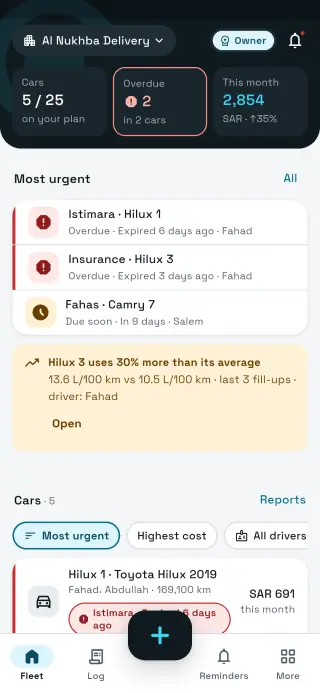
Clauses 2 and 8: every car is assigned to one or more drivers in the app, and every entry records who logged it, so you know who was responsible for the car on any day. Clause 5: drivers log fill-ups from their phones with a receipt photo, even offline. Clauses 6 and 7: service reminders by km or date go to the owner, managers and the car's driver. And an alert when a car uses more fuel than its average helps the monthly review. Drivers see only their own cars, never other cars' costs.
There's no single mandatory form, but it's part of your internal work rules. To make it enforceable, tie it to the employment contract or company rules and have each employee sign it.
Yes, the company decides how its cars are used. What matters is that the rule is written, clear and applied to everyone.
Your policy and the employment contract decide. The common rule: the driver bears driving fines, the company bears administrative ones. The assignment record shows who was driving.
Every year, and after any big change: new cars, a new type of work, or a change in regulations.
No need. Name, internal employee number, car and signature are enough; the ID is already in the employee's file.
We write practical guides on car costs, maintenance and company cars. Every number has a source.
From Sayarti+ — sayartiplus.com · Not affiliated with any government entity