

Monthly car costs: a line-by-line example in SAR and EGP
What does your car really cost each month? Two full examples in SAR and EGP: fuel, oil, tyres, insurance, fees, and the cost people forget: depreciation.
Reviewed 8 min read
 Sayarti+ teamReviewed 7 min read
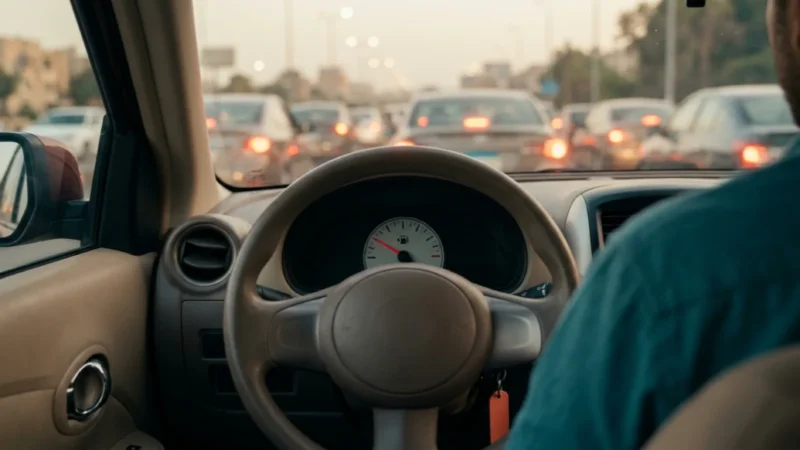
The most common reasons a car uses more fuel: aggressive driving in traffic (up to 40%), AC in extreme heat (up to 25% on short trips), 120 km/h instead of 100 (about 20%), a roof rack, and low tyre pressure. But first confirm it with the right maths, full tank to full tank, not the dashboard figure.
Many people go by feel (“the tank empties faster”) or the dashboard figure, and both can mislead. The feeling is coloured by a higher price per litre or more trips this month, and the dashboard number is an estimate that can be off. The right method is simple:
Example: You filled up at 52,300 km. Next time the car took 42 L at 52,780 km. Distance 480 km, so consumption = 42 ÷ 480 × 100 = 8.75 L/100 km (about 11.4 km/L).
Repeat over at least three fill-ups and take the average, because a single fill-up can be skewed by a road trip or unusual traffic. If the new average is more than about 10% above your car's usual figure, there's a cause worth finding.
These figures come from the US Department of Energy (fueleconomy.gov) and Natural Resources Canada. They're approximate and vary by car, road and weather, but they show where to start: the biggest effect and the easiest fix first.
| Cause | Extra fuel | What to do |
|---|---|---|
| Aggressive driving | worst in traffic) | Smooth starts; look ahead to anticipate lights |
| AC in extreme heat | up to 25% (short trips most) | Air out the hot cabin for a minute, then use AC; park in shade |
| 120 km/h instead of 100 | ≈ 20% | Ease off on the highway |
| Roof box or rack | 2–17% (من المدينة إلى الطريق السريع) | Take it off when you don't need it |
| Under-inflated tyres | 0.6–4% | Check pressure monthly with cold tyres |
| Wrong oil grade | 1–2% | Use the grade in your manual |
| Extra 45 kg | ≈ 1% | Clear heavy things out of the boot |
Rough figures; they vary by car, road and weather. Sources: US Department of Energy (fueleconomy.gov) and Natural Resources Canada (NRCan), 2026.
Good to know: What about the air filter? On modern fuel-injected cars, a clogged filter hurts acceleration but barely affects fuel economy, according to the US Department of Energy. Change it on schedule, but don't expect it to fix your fuel bill.

If you've ruled out driving style, AC, speed and tyres and consumption is still high, the cause may be a fault. These are the usual suspects, and all need a mechanic's check:
Also watch for changed conditions, not just faults: moving further from work, short school runs every morning, or a longer summer all raise the average with nothing broken.
Read next: How often to change engine oil · Tyre age and date code
Example: a car that averaged 8 L/100 km now uses 9.6, a 20% rise, and covers 2,000 km a month. That's 32 extra litres a month. At SAR 2.33 a litre, the October 2026 price of 95 in Saudi Arabia (Saudi Aramco), that's about SAR 75 a month, nearly SAR 900 a year. In Egypt at an example EGP 19.25 a litre (an illustration, not today's price) it's about EGP 616 a month. The current price is in the box alongside.
Log each fill-up in three fields (odometer, litres, price or amount), and Sayarti+ works out consumption full tank to full tank, even with partial fill-ups or one you forgot to log, and charts every fill-up. A sudden jump in the chart flags a problem before it costs you much. For company cars, Sayarti+ Business alerts you when a car uses clearly more than its usual average.
Read next: Fuel consumption sheet for company cars
Most often: aggressive driving in traffic, AC in heat, high speed, a roof rack and low tyre pressure. Then faults such as sensors or sticking brakes.
Calculate full tank to full tank over 3 fill-ups and compare with your usual average. More than about 10% higher is worth investigating.
In extreme heat it can add up to 25%, most on short trips. On the highway, AC is better than open windows.
On modern fuel-injected cars, usually not, according to the US Department of Energy. It helps acceleration, so change it on schedule.
Drive smoothly, keep highway speed moderate, keep tyres at the right pressure, remove the roof rack, service on time, and cut idling.
The dashboard figure is the car computer's estimate and can be a few percent off. Full-to-full maths is more accurate because it uses the actual litres.
We write practical guides on car costs, maintenance and company cars. Every number has a source.
From Sayarti+ — sayartiplus.com · Not affiliated with any government entity