
Car battery life in hot weather: signs and when to replace
How long a car battery lasts in Gulf and Egyptian heat, why heat kills batteries faster than cold, the warning signs before it fails, and when to test it.
Reviewed 6 min read
 Sayarti+ teamReviewed 6 min read
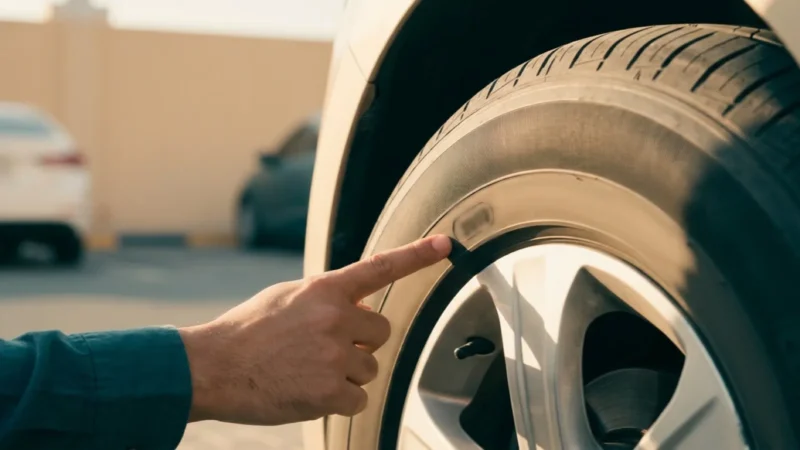
A tyre's manufacture date is the last four digits after “DOT” on the sidewall: the first two are the week, the last two the year, so 2324 means week 23 of 2024. There's no single agreed expiry, but have tyres checked every year once they're 5 years old, and replace them at the first crack, bulge or worn tread.
Look at the outer sidewall for the letters DOT. A string of letters and numbers follows, ending in four digits, often inside a small oval. Those four digits are the manufacture date. If you can't find them, they're on the inner sidewall facing the car: some factories print the full code on one side only.
| Code | Meaning |
|---|---|
| 0524 | Week 5 of 2024 (early February) |
| 2324 | Week 23 of 2024 (early June) |
| 4719 | Week 47 of 2019 (late November) |
| 3 digits only | Made before 2000: replace it now |
Tip: When buying new tyres, read the code before fitting. A “new” tyre may have sat in a warehouse for a year or more. Ask for tyres made this year or last year, and have the code written on the invoice.
A tyre's life is measured in two ways at once: the kilometres it covers and the years it lives. Tread wears with driving, but the rubber itself ages with time, sun and heat even if the car barely moves. That's why you can find a tyre with deep tread that is cracked and unsafe.
| By km | No single number: it depends on the tyre, driving, load and pressure. The limit is the wear bar inside the groove, at 1.6 mm of tread. If your tyre has a maker's mileage warranty, it's in the warranty leaflet. |
|---|---|
| By age | Michelin, for example, advises a check by a tyre professional at least once a year after 5 years of use, and replacing a tyre 10 years after its manufacture date even if it has tread left or looks fine, spare included. In the heat, don't wait for the maximum: the yearly check decides. |
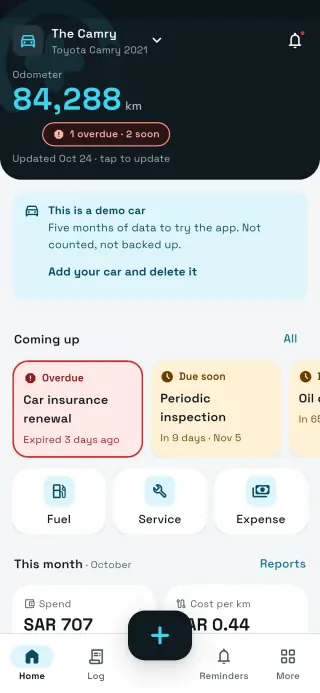
| In Sayarti+ | Default reminder: check tyres for replacement every 40,000 km or 4 years, whichever comes first, and rotate every 10,000 km. You can change both. |
In summer in Saudi Arabia, the Gulf and Egypt, asphalt gets much hotter than the air, and direct sun speeds up cracking in the rubber. Heat raises the air pressure inside the tyre, and long highway runs between cities add more heat. The most common cause of a summer blowout is low pressure: an under-inflated tyre flexes more, so it runs hotter.

Tip: Coin test: put a coin in the deepest groove. If its top edge shows completely, the tread is low and worth measuring at a tyre shop.
Watch out: The spare has an age too. Many cars carry a spare as old as the car. Read its date.
In Egypt tyres are called «كاوتش», and the same code is on the sidewall: four digits after DOT. City traffic, speed bumps and heat add wear, so check pressure every two weeks in summer. Be careful with used tyres: read the date before you buy, because good tread doesn't mean sound rubber.
Write down each tyre's date code and the odometer on the day it's fitted. In Sayarti+, log the tyre change once as a service: it reminds you to rotate every 10,000 km and to check for replacement at 40,000 km or 4 years, whichever comes first, predicting when you'll reach the km from your average driving.
Read next: Car battery life in hot weather · Why your car uses more fuel
There's no single number. Have them checked yearly after 5 years from manufacture; Michelin, for example, advises replacing them 10 years after manufacture whatever their condition. Cracks or bulges mean replacement at any age.
On the sidewall after the letters DOT: the last four digits. If they're not on the outer side, check the inner side.
There's no single number; it depends on the tyre, driving, load and roads. The limit is the wear bar at 1.6 mm of tread, and age in years matters just as much. Sayarti+ reminds you to check at 40,000 km by default.
Better to buy one made this year or last. A well-stored tyre ages slower, but you'd pay a new-tyre price for a shorter life.
Heat alone rarely does; heat plus low pressure, high speed and a heavy load is the classic cause. Check pressure with cold tyres before a trip.
We write practical guides on car costs, maintenance and company cars. Every number has a source.
From Sayarti+ — sayartiplus.com · Not affiliated with any government entity