Tyre age: how to read the date code and when to replace
Read a tyre's manufacture date from the four digits on its sidewall, learn when a tyre is too old even with good tread, and why heat ages it faster.
Reviewed 6 min read
 Sayarti+ teamReviewed 6 min read
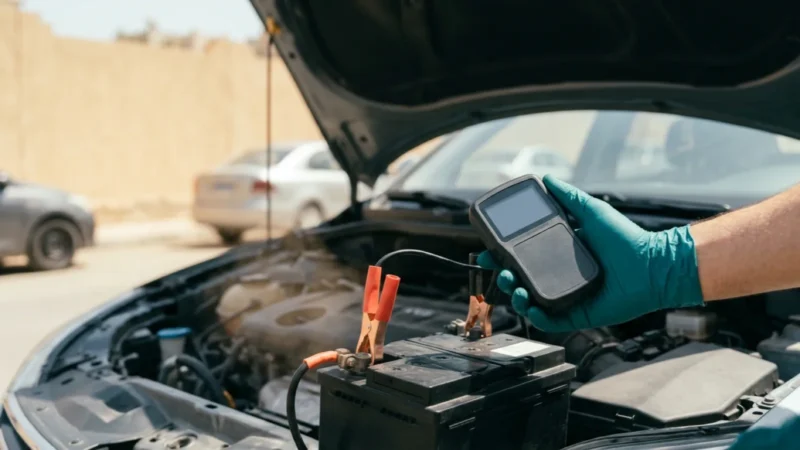
In hot climates a car battery usually lasts two to three years, versus five or more in cool ones. Heat wears it out from the inside even when nothing shows. Have it tested every 6 months after its first year and before every summer, and replace it at the first sign of a slow start.
The American Automobile Association (AAA) says a battery lasts about five years or more in cool regions, but around three years on average in hot ones, and as little as two. Summers in Saudi Arabia, the Gulf and Upper Egypt are harsher than most hot US regions, so it's wise to plan for the shorter life.
| Cool or mild | 5 years or more |
|---|---|
| Hot (Gulf, Egyptian summer) | 2 to 3 years |
| Car parked long in the sun or used for very short trips | Can be under 2 years |
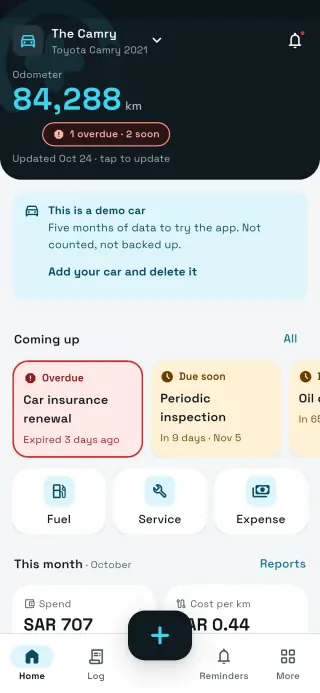
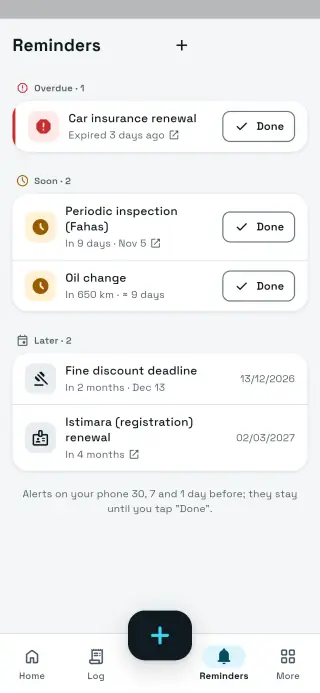
| In Sayarti+ | Default reminders: test every 6 months, replace every 24 months; both editable |
Good to know: A new battery isn't new from the day it's fitted. Its case has a stamp or sticker with the manufacture date. Ask for one made in the last few months, because batteries lose charge sitting on a shelf.
People link weak batteries with winter, because cold exposes the weakness: a cold engine needs more power to start. But the real damage happens in summer. Heat speeds up the chemistry inside the battery, so its plates corrode faster, some of the liquid evaporates in batteries that take water, and it drains itself faster while parked. Then a cool night or winter morning comes, the car won't start, and the cold gets the blame.
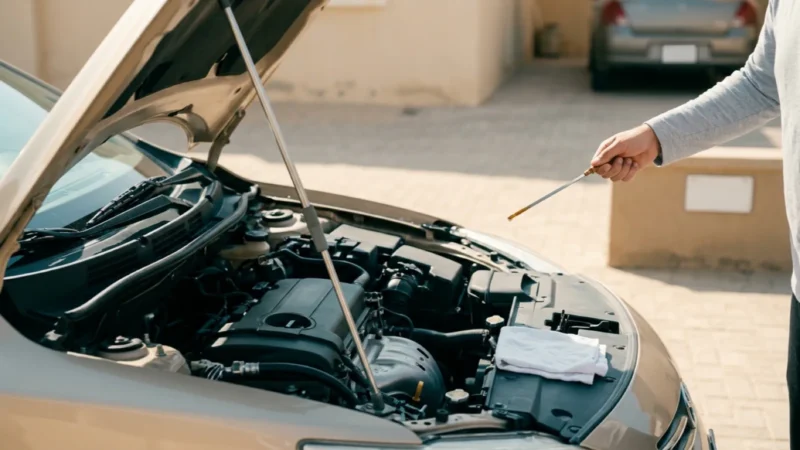
Under the bonnet it's much hotter than the outside air, especially in traffic with the AC on. That's why some modern cars put the battery in the boot or under a seat, or wrap it in a heat shield. If your battery has a heat shield, put it back after any replacement.
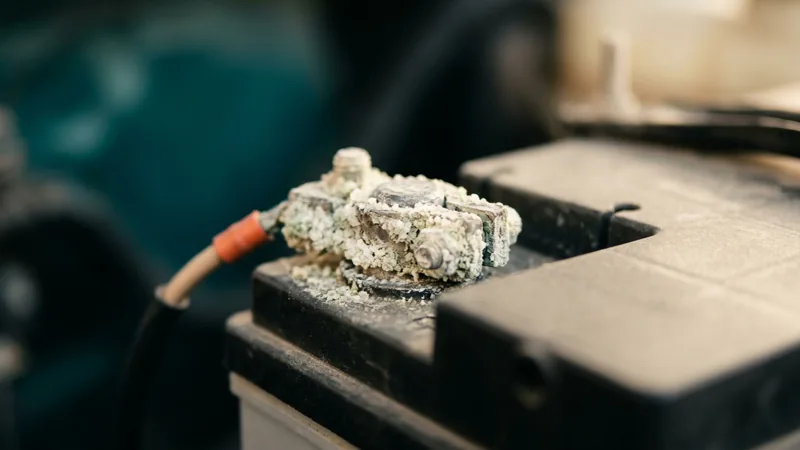
Watch out: A swollen or leaking battery is dangerous. Don't charge it or jump-start with it; have it replaced.
The most accurate check is a load test, or the battery tester most battery shops and auto-electric workshops have, which gives the battery's health as a percentage. Ask for it every 6 months after the first year, before every summer and before any long trip.
| Voltage | |
|---|---|
| 12.6 فولت أو أكثر | Fully charged |
| أقل من 12.4 | Undercharged: charge it soon; leaving it like this damages the plates (sulfation) |
| حوالي 12.1 | About 50–60% discharged: charge it, then load-test it |
Rough values for a standard 12 V lead-acid battery; voltage alone doesn't reveal every weakness, a load test is more accurate. Some deep-cycle AGM batteries read about 13.0 V when full; check your battery's spec sheet.
Price depends on size (amp-hours) and type: standard, sealed maintenance-free, or AGM and EFB for cars with start-stop. More important than price is matching your manual's spec: size, amp-hours and cold-cranking amps (CCA). A car with start-stop needs a battery of that type, or it will fail early. Many shops take your old battery and knock its value off the price, so ask. Get quotes from two shops; prices vary a lot by size, type and brand.
Log the battery's price, fitting date and odometer. That way you know how long it really lasted, and whether the warranty still applies if it fails early.
When you fit a new battery, log it in Sayarti+ as a service. The app reminds you to test it every 6 months and to replace it after 24 months; you can change both to suit your battery and climate. Its price and date stay in the car's log, with a free photo of the receipt and warranty.
Read next: Tyre age and date code
Usually two to three in hot climates and five or more in cool ones. Test it every 6 months after its first year.
Slow cranking, dimming lights, the battery light, odd electrical glitches and start-stop not working. Swelling or a smell means replace it now.
A maintenance-free battery doesn't need water, so it tolerates neglect better, but heat still wears it. Life depends on quality, climate and use more than type.
With summer heat and city traffic, usually two to three years. Test it before summer and before trips.
Not necessarily. Charge and load-test it; if it passes, the cause may have been a light left on. If it happens again, replace it and check the alternator.
We write practical guides on car costs, maintenance and company cars. Every number has a source.
From Sayarti+ — sayartiplus.com · Not affiliated with any government entity